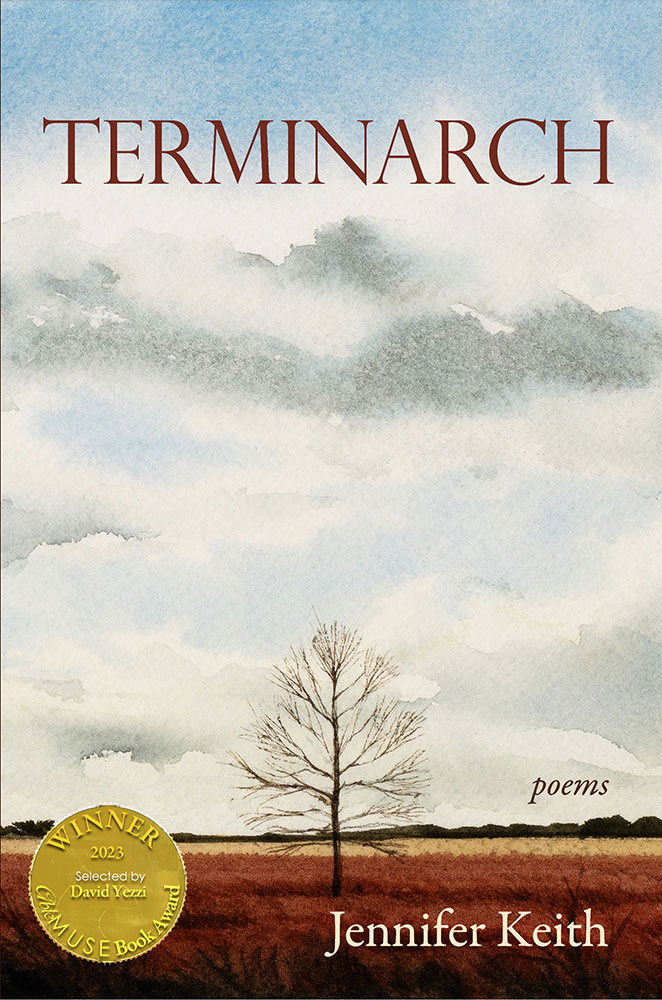
Jennifer Keith’s brilliant Terminarch is filled with endings and endlings: the rabbit “terrified” by a hawk’s “skeleton dance,” Captain Quint’s final slide into the shark’s mouth in Jaws, or Martha, the last passenger pigeon, closely watched up to the moment “she’d finally meet / good Mister Audubon.” A rescued alligator plant proves so dangerously hardy that it has to be destroyed, becoming a metaphor of malignancy, while “Under the Ice” offers a literal rebirth when its resuscitated protagonist survives shock and hypothermia, “in the world, and of it, as of now.” Equally adept in meter or free verse, Keith charts the endings of relationships and the beginnings of new ones, the burdens of chronic pain and the bliss of restored love, as when what first appears as “random dust” turns out to be “a clean parabola of light / that issues from a comet.” Both earthy and unearthly, the poems of Terminarch streak—vividly and unforgettably—across the page.
— Ned Balbo, author of The Cylburn Touch-Me-Nots and 3 Nights of the Perseids
This beautiful debut by Jennifer Keith rewards its readers with the poetic riches of an author deeply skilled in her craft. From the dark backdrop of pain and loss, Keith’s imagery emerges, luminous and allusive, a gorgeous linguistic chiaroscuro, shedding light on the classic yet ever-relevant themes of poetry: love, mourning, beauty, and “the gaze”—the current state of our world. Terminarch—an endling, the last of its kind—delivers poems that will linger, “ink and memory,” in the reader’s mind.
— Moira Egan, author of The Furies
As with the fate of the passenger pigeon—hunted out of existence in “Martha in Cincinnati”—discontinuance is the haunting subject of Jennifer Keith’s powerful and elegiac Terminarch (the word means endling, the last of a line). These expertly composed poems pick through the aftermath of loss: “The salad bowl, the paperbacks and cache / of costume jewelry, socks, uneaten meat: / My treasure’s now reduced to abject trash . . .” Stirred by the passing of parents and friends, the poet remains “in the world, and of it,” even as she hopes to forestall the darkness to come: “The sleet against your window will not reach you yet. / You pray that someday, something other will.” Clear-eyed, compassionate, and deeply felt, Keith’s poems affirm such slender, innate hopes with their enduring beauty.
— David Yezzi, author of More Things in Heaven: New and Selected Poems